Nothing like filing taxes to get you thinking about last year. It wasn't a great year for my writing, but I did log my first story sale (actual money for something I wrote). I won't disclose figures, but it was enough to buy a twelve pack.
I wrote a children's book that I really liked, called "The Ice Boy." Oh, and another, called "Boris and the Spiders." And I heavily edited a story I wrote apparently in 2012, called "The Rubber Band Man in the Moon." These are all middle grade chapter books, of about the 5000 word variety. I write them, edit them to death, and then don't somehow know what to do with them.
I also wrote (it looks like) four short stories. Like I said, not a great writing year.
Apparently I did a lot of editing. I know this because I wrote a note to myself to this effect. For instance, I took a novella and added in a story thread that gives the main character a lot more depth. I added a whole subplot to another. I raked through one of my novels again. And I deeply edited a story that went through a round of critiques.
Looks like I submitted 22 manuscripts (some as many as 3 times), and almost all of those in the first nine months of the year. This was one those Ray Bradbury "snow flurries of rejections slips" periods, although 22 probably isn't that many. I need to up my game, this I know. Time to get my feet wet submitting the longer stuff, too.
On the up side: three of those rejections came with compliments, what I could call "near misses." One of those was a major market, a "professional" one. So that was very nice. And, it bears repeating, one came with with a "yes" and a small deposit in my account.
Oh, and I almost forgot: This blog hit 10,000 all-time views. It might not be a sky-rocket, but I'll take it. Thanks for reading!
Why am I telling you all this? I don't know. Camaraderie, maybe. The hope that it'll encourage one of us to keep moving forward? Yeah, it's probably that.
Showing posts with label writing. Show all posts
Showing posts with label writing. Show all posts
Saturday, February 14, 2015
A Writing Year in Review

 John writes mythic fantasy and science fiction for adults and children. His latest story, "Son of Mist," appeared in the April edition of Bards & Sages Quarterly. Check out his webpage for some free stories.
Monday, October 27, 2014
Forget need: write from joy
 |
| "Oh Joy!" by dank1012 |
I'm going to talk to myself out loud for a few paragraphs. You're welcome to listen in.
I've heard the advice that you should only write that story that grips you and won't let you go. You should write because you have to. You should write out of some kind of dire necessity. And I do believe there's truth in that. A lot of truth, and maybe even most of the truth.
But that's not the whole truth. From another angle, as I wrote in a recent post reflecting on playing cornet (for no earthly or professional reason), too much of our lives are devoted to duties. Things we have to do, because if we don't do them ... whatever will happen. I won't be able to pay my bills. My kids will grow up to hate me. My such-and-such will get mad at me. Whatever it is. Duty calls, and we jump to our feet (grudgingly, but quickly). And the deeper the need, the quicker our response, the more attention and energy we give that thing, and the harder we push to "do it right."
Writing, I think, shouldn't be like that at all. Or at least not the kind of writing I'm interested in. A story that has to be written is, well, a newspaper story written for a deadline. Or a sequel to a novel promised by the writer, or demanded by a contract. (I respect both of those kinds of writing, by the way. But it's not what I signed on for here!) Freedom--the kind of freedom that is essential to art--has to come from a different place. It has to come from a kind of joy. Or at least "joy" is one of the places it can come from. A superabundance, an exuberance, an overflow, an excess.
That, I admit, is its own kind of necessity. And it might be the necessity these advice-givers have in mind. But its primary trait is not, I think, need. Its primary trait is "joy." Or "enjoyment." Delight. Ecstasy. Richness. Excess. A freedom from duty, a desire that transcends the demands of everyday life, that celebrates "waste" and "profligacy." Just look at the endless hours spent clacking at a keyboard to produce a small piece of excellent, exquisite prose. Novels write far slower than they read. If they existed for reading alone, they would never be written. The writer would collapse under the pressure of duty, the duty to produce what was demanded.
The same could be said about painting. It doesn't exist only to be looked at and seen. If it did, what painter could bear the strain to produce a finished work?
So novels are written for another reason altogether. Call it "need" if you want, I prefer "joy." The very best novels are experiments in delight, distillations of endless lingering, idiosyncratic and meandering, exploratory and clever, taking the time to shed light on some aspect of life, or just to tickle some curious itch. There are mercenary novelists, I'm sure. But like I said, I'm talking here to myself about the kinds of novels I enjoy reading and would want to write. They all have that trait of exuberance, even if it's the sparse lines of Hemingway or the voluble passages of Dostoevsky, the vivid descriptions of a Neal Stephenson, the arms-length humor of H. G. Wells, the lush prose of Patricia McKillip, or the ascetic blade of Ursula Le Guin. None of these writers, I think, are writing because they have to--out of some kind of duty imposed on them from an external force. (Dostoevsky sometimes did, I realize, to pay bills. But that's beside my point.) It might not even be that they have to write this particular story because its teeth got into them. It might be that they have found room in their life, in the internal space of their interior life, to play. (Play, either frivolously, or with great earnestness. But play, nonetheless.) And in playing ... out came these delights.
I don't know if that's the way to say it. But there's something true in what I'm trying to articulate here. Something that the advice to write "what you have to" has never conveyed to me. Writing, for me, has to live outside the realm of "duty." At least for now. It has to exist in a place that's free of those kinds of mercenary constraints. It thrives on exploration, on a rich diet of leisure and thought and space and time. From there a story might well seize me and not let me go. But it seems to me it's more often the reverse: that I seize a story, an idea, an inkling, that emerges from that rich interior life, and I don't let it go until I've found out the insight it's hiding in its murky depths.
Stories, to me, don't come fully formed, but rather as semi-conscious or even unconscious nudges that I have to seize and follow out if I want to understand them. I can go on without them--and have--but I'd rather take hold of them. This doesn't feel like necessity, but rather opportunity. A chance to find joy, to pursue my bliss.
John writes mythic fantasy and science fiction for adults and children. His latest story, "Son of Mist," appeared in the April edition of Bards & Sages Quarterly. Check out his webpage for some free stories.
Friday, October 17, 2014
Wind in My Sails
 |
| This cornet is exactly like mine (including the case) You can get one for under $100 |
What's fun, oddly, is the discipline of doing something that has no professional purpose or possibility. Writing used to be that way, and then I got the crazy notion of trying to publish some things (not that I try that hard, but I do try). On cornet, I'm just a guy in his forties blowing sound out of a brass pipe.
But the process of learning to hold the instrument to my lips, and create from my body a sweet sound, is its own reward here. Most of my playing is done in a practice room at the college. If other people can hear me, they mostly have my sympathy. I'm not there to impress anybody. I just want to do it right, not because of some duty but for the sake of creating a pure sound, a sweet and clear tone.
Not many things in life are like this, I think. Most of what we do is for duty--that's been my experience. Why else do I get up at the crack of dawn? Why else do I read certain books and put in my hours and go here and there running around in the car? All of that--a good chunk of my life--is for nothing but duty.
But playing a horn that nobody can hear, and disciplining my body to learn to breathe, and my lips to buzz, and my jaw to stay in position ... all this is just completely outside of any necessity whatsoever. I'm doing it because I want to. And nobody else wants me to ... er ... expects me to.
I guess writing is like that still, even in spite of my feeble efforts to publish what I've written. I don't do any of that because I have to. I'm not a starving artist with no other skill set. (Maybe that's why I'm not more driven to send out my work.) Nobody's expecting me to write something or put it in the mail. The closest I get to that is writing I do for work which, partly for that reason no doubt, feels like drudgery and toil. And I suppose disciplining myself to learn the craft of fiction, how to shape a narrative, how to hone description and bring out voices and delve into the red blood of a character ... all that is for the sake of doing it right, getting that "clear tone," too. I do want to make my stories sing, for myself first and foremost. And here comes the other reason I don't send things out as diligently as I should: I can hardly get a better rush than when I know the story is right, in the quiet of my own study. (And more often it's something far worse than a rush that I get back from my endeavors to interest an editor in my delicacies.)
At some point, I know, I am going to want to step out of the practice room and play a few tunes in the hearing of human ears. I'm not there yet, but when my horn is responding to me the way I'd like it to, that moment won't be far behind. Even then, it won't be performance that I'm after. I'll want the joy of playing with other musicians, contributing my horn's voice to a larger whole, on the sweet sounds set down by a genius. If writing could somehow be more like that, I suppose I'd be less timid. But every bit of words scratched on paper--even this half-random blog post--feels like a performance, even if only to me. When it's read, there's a finality to it that a musical rehearsal doesn't have. That's not always true--critique groups break the rule there--but it's often enough true. And out there in the world of professional performance, there be wolves and dragons.
So maybe that's my last hurdle, the reluctance that keeps me close to the vest. Who knows? Who cares? What matters tonight is that I've found little gusts of joy that, in spare moments, refresh me, like a cool wind on the sea, filling my sails.
John writes mythic fantasy and science fiction for adults and children. His latest story, "Son of Mist," appeared in the April edition of Bards & Sages Quarterly. Check out his webpage for some free stories.
Sunday, September 7, 2014
Quietly Writing
 |
| "Solitude" (Flickr: vonderauvisuals) |
In this loud culture of "all talk, all the time," where even taciturn writers like myself are asked to "create a web presence," network like high-powered corporate types, and "market yourself relentlessly," I'm learning to pull back and enjoy a nice long steep in solitude.
This summer, I spent a lot of time reading, joined a critique group, bought a one-person fishing kayak, edited like mad, and sometimes wrote new material. It was nice to give myself permission to enjoy what we in our house call "alone time." That's where we all go when we get overstimulated, stressed, and in need of a recharge. Maybe you have your own version of alone time. Maybe you golf or go for a jog. My version often involves reading or writing quietly in a chair.
It occurs to me that one cannot read or write loudly, or in a vivacious and extroverted manner. A writer, alone in a room, with the implements of his trade--laptop or paper--before him, all distractions tuned out. The door closed. This, as we all know who write, is how you get things written. There is, as the old proverb has it, a time for everything under the sun. A time to speak boldly in front of others, a time to be gregarious and delight new acquaintances. Even a time to promote oneself. But of course the quiet labor of writing belongs to a different time from all of that, and can only happen where that separate time is set aside and the outside world is shut out.
Or, actually, not the outside world per se. The world of nature, the colors and sights and sounds, all enter into the thing. And even the world of human society, from which I will have retreated for the sake of doing the actual writing, nonetheless leaves its echo on my mind. In fact, I think of this tendency to become overstimulated as a gift, because it makes human society vivid in my memory. The brilliant impression of being around others helps me see human interaction clearly when I'm alone in my study, like a well exposed photograph. And that in turn helps me be true to it when I'm writing in solitude. It's a gift, because, again, I can't write except in solitude. And it usually happens that there are going to be people in whatever I'm writing--people I'd like to get down on paper, now that I've taken their measure out there in the real world.
When I'm out in the world, if I've had time to recharge quietly--like I did this summer--I'm more alive to what I'm seeing. I take all this human flux into me, and all the texture of nature, or city streets, or the thick air of a summer afternoon. When I can get it like that, I can distill it within, until I'm full and it's time to retreat again.
I wonder what it must be like to ride on the surface of all that sensory input? I'm so deep in its throes that I get overwhelmed. But again, that's a gift, because from where I am down in the pounding pulse of that cacophony of noise and color, I might get lucky and see what drives it.
Of such good summers are rich autumns made. I expect to be more fully alive to the people and things around me, and so all the richer in my interior life. And that can only go to improve the quality of what I write, or think, when I'm in that solitary place. Quietly writing.
John writes mythic fantasy and science fiction for adults and children. His latest story, "Son of Mist," appeared in the April edition of Bards & Sages Quarterly. Check out his webpage for some free stories.
Friday, July 25, 2014
Fairy Tales and Other Short Stories
Before Anton Chekhov and the modern period, people still enjoyed the occasional short story, apparently. These short stories were so good, folks told them over and over again. They memorized their plots, their main characters, and some of the spoken parts, and they passed them along orally from town to town and generation to generation.
In fact, those stories were so good, that you know some of them. What's more, many of those stories' plots have been adapted for film, woven into novels, captured in visual art forms of every kind. The first animated films were based on them, and television shows running this season are still trying to tap into their popularity.
What modern short story can claim that kind of power -- the power and influence of the traditional folk tale?
+500.jpg) |
| Recognize this tale? (Photo by JP) |
To get at the issue, let's consider what sets these old tales apart. Not their length, obviously. The presence of magic? Well, no, not if you include fantasy short stories in the mix. Here are some key traits, in no particular order.
- They have no known author. But this is only partly true, because some of the most successful examples of this genre were composed by Hans Christian Anderson, Madame Gabrielle-Suzanne de Villeneuve, and others. Most weren't -- they were collected and edited, but not invented, by known figures. But even the ones that were draw on a folk tradition of storytelling and, from this tradition (as a support for the personal inventiveness of the author), they draw some of their power. The conscious use of tradition gives these tales a breadth of perspective, rather than the peculiar perspective of one (let's face it: usually not that well adapted) member of society.
- The characters are sharply drawn. We know folktale characters by what they do, not how they feel about things. A modern critic would say such characters are just "types" or even stereotypes, lacking internal complexity. A post-modern critic will likely complain that "good" and "evil" are too neatly divided between the characters (though this isn't always true). But there is no question that the reader knows who the "hero" is and what sort of persons the hero and antagonist are. Perceptive readers (modern or post-modern) can find ambiguity in both -- a delicious exercise when done well.
- They take you on a journey. With only one exception I can think of, the hundreds of folk tales I have read all move, they all take the reader to some new place, however bizarre or unanticipated. Unlike many modern short stories, never do folktales study, as in a still-life, a particular moment of the main character's life, or some complex situation peculiar to our society. In fact, short story purists insist that this folktale tradition is wrong. But some genre short stories, in my experience, play with a similar dynamic, extending over days. Few if any cover the same stretch of terrain as, say, the Nix of the Millpond (a man's entire life) or even Cinderella (a girl's birth to coming of age).
The really tricky part comes when some of us lovers of folktales (myself included) try to write short stories. We obviously can't help the first bullet point above, although we can draw more (or less, but why would we?) on the folktale tradition. We can and probably must choose to flex the borders of bullet point two: We may need to say something about what motivates our characters and how they feel about things, to satisfy today's readers. And we might (for a variety of reasons) feel that humans are morally complex.
But at bullet point three, I think the choice has already been made for us -- at least that's true for me. If you like folktales, you won't get much pleasure from a short story that doesn't go anywhere, that microscopically analyzes the human emotions present in a particular moment. And vice versa, by the way. (I've been told by one of these purists that wanting a story to "go somewhere" means I just don't like short stories!) I would argue for a compromise here: agree to disagree. Recognize that there are (at least) two kinds of short story.
There's value in both, in my view. One trait traditional folk tales share with modern short stories is an interest in exploring human nature. That's why these tales have this kind of staying power. Many of them -- and above all, the most successful ones -- reveal something profound about what it means to be human, to live here on earth where wild woods infringe and evil desires lurk. Where everyday people are capable of unspeakable horrors and astounding acts of courage. And you get to ask: What sort am I? What if ...?
Thoughts? What sort of short story do you like, if any? What makes one work for you? Any tips or ideas to share for connecting these two very different sensibilities (modern and traditional) in a short tale?
John writes mythic fantasy and science fiction for adults and children. His latest story, "Son of Mist," appeared in the April edition of Bards & Sages Quarterly. Check out his webpage for some free stories.
Sunday, April 28, 2013
Thoughts on The Handmaid's Tale, by Margaret Atwood

By intuitive, I mean that kind of writing in which you allow character, setting, dilemma, to lead the way, rather than a pre-arranged plot. You, the writer, don't know what's going to happen--or at least, not very clearly how you'll get there--when you sit down to write the first chapter. Some people call this the "pantser" (vs. "plotter") approach--writing by the seat of your pants. Bradbury put it like this: "Find out what your hero wants, then just follow him."
Here are my reasons for thinking Atwood tackled The Handmaid's Tale this way:
1. The scenery/environment is well developed, but the trajectory of the main character (Offred) is episodic for much of the book. It lacks a clearly defined "plot."
2. Offred is fully realized; her inner life is available to the reader--or at least as much as it is available to her. This is virtually impossible to achieve, as far as I can tell, in a highly plotted novel, for the simple reason that the characters become cogs in the machinery of plot. In such a novel, the complex, layered thoughts of a character tend to be more hindrance than help, since they'll often lead to unpredictable actions that derail the plot.
3. Atwood remarks that she knew where the story was going, so she didn't have to query herself about it; this suggests that she sometimes does have to query herself--meaning she doesn't plot out in advance. So did she this time? I doubt it. Knowing where the story is heading is a sign of a very realized sense of the character in relation to the situation in which she's been placed--her limitations, or parameters, within that situation, and within her particular personality.
This, in my view, would not mean there would be no persons, situations, or even characters arising in the unfolding of the story that the conscious mind has not planned in advance. For instance, when Atwood placed Offred in a relationship with a married man (in her past; "Luke"), did she foresee the tension this would create with Serena Joy, the wife of the Commander for whom she's a "handmaid"? Or did this rather come to her in the telling of the story, a "lucky happenstance," a chance encounter that presented another layer to the story? Because, to me at least, this element complicates a simple before=good/after=bad equation. And I find it convenient to suppose that Atwood's subconscious resisted that equation, more than (or as much as) her conscious mind.
But, of course, I'm only guessing. Call it intuition.
Well, I promised "thoughts" and really have only given you one. So let me add another, unrelated: Somehow it doesn't bother me that Atwood has distanced herself from sci-fi. In one article I found (in the Guardian), she admits to writing sci-fi, "or speculative fiction, if you prefer." A writer like her, working in "literary" fiction as well as speculative (or sci-fi), can be excused for wanting to distance herself from space octopi. Just saying.
If you've read the novel (or better yet, an interview or confession I couldn't find; or better still, you are Margaret Atwood) and you'd like to weigh in, I'm all ears.
Update: I overlooked an interview with Margaret Atwood in The Paris Review when I was writing this post. It turns out I was right. Here's what she says:
When I’m writing a novel, what comes first is an image, scene, or voice. Something fairly small. Sometimes that seed is contained in a poem I’ve already written. The structure or design gets worked out in the course of the writing. I couldn’t write the other way round, with structure first. It would be too much like paint-by-numbers. As for lines of descent—that is, poem leading to novel—I could point to a number of examples. In my second collection of poems, The Animals in That Country, there’s a poem called “Progressive Insanities of a Pioneer.” That led into the whole collection called The Journals of Susanna Moodie and that in turn led into Surfacing. Or, another line of descent, the poems in parts of True Stories have obvious affiliations with the novel Bodily Harm. It’s almost as if the poems open something, like opening a room or a box or a pathway. And then the novel can go in and see what else is in there. I’m not sure this is unique. I expect that many other ambidextrous writers have had the same experience.
John writes mythic fantasy and science fiction for adults and children. His latest story, "Son of Mist," appeared in the April edition of Bards & Sages Quarterly. Check out his webpage for some free stories.
Saturday, March 23, 2013
Editing as Following the Story
 | |
|
What I've come to see this time through the story is that I've gotten better at what feels like an essential skill of my craft: following the story. Seem obvious? At the rewrite stage, this is very difficult to do. There's a kind of inertial drift to the story. It goes this way, because it's already down on paper this way. And something in me has tended to resist upsetting the order or the drift of the words already there. One has to get past that readerly impulse that treats a story as a thing complete, wrapped around in cellophane, observable but beyond shaping. "Following the story" is different than reading what you've already written. It may mean ignoring what you've written.
The whisper of the story comes, for me, by way of nagging sensations of doubt. What is my hero doing here? What happened to the wound he received on page 12? Why is this land lush and green and not dry and wind-blown? Or why is it built up like a medieval fortress when it should be earthy and wild?
The key, the thing I feel I'm getting better at with practice, is the capacity to trace the offending element to its root and excise it. But rarely can you get away with a surgical removal. The thing that's offending is bound up with your original misperception of the story. In taking it out, you are changing the fabric of the whole. And so, at least for me, you have to begin following the story forward again, from that point. You have to listen patiently for every change that your excision requires, as you read, edit, rewrite, rework, mold the materials of the story.
But it's this constant listening, this ear to the story, to following its course as you would a fragile stream in a thick wood, under heavy brush and leaves, not knowing--again--where precisely it will take you. It's the admission that you're following--not reading, but searching out the story again. That's key.
John writes mythic fantasy and science fiction for adults and children. His latest story, "Son of Mist," appeared in the April edition of Bards & Sages Quarterly. Check out his webpage for some free stories.
Sunday, February 10, 2013
iA Writer - My Review
This is the first text I've typed on my new text editing program, iA Writer. App purchasers crowed about how it helps you focus on the text you're writing, and not get distracted by formatting and other things. I don't consider myself a highly distractible person, but I have noticed a tendency to perk up when an email comes into my box. And then there's the occasional icon that tempts me into doing "something else."
The app was on sale (for a limited time!) for $5. And I had an iTunes gift card from Christmas which, admittedly, I should be using for music, since I don't have much. Or should I? Considering that I don't often invest in writing tools, maybe this is the best option. (This is a Mac app, if you haven't figured that out.)
It's early in the game, but I must admit the experience is different. My screen feels more like a type-written page and less like a computer monitor. And yet in some ways I suppose it feels more like an old-fashioned monitor.
In Full-screen mode, you see nothing but what you're typing, and about 21 lines of text (mostly) above it. There's nothing else but a lot of "white space" at the margins; and you have to hover the mouse at the bottom to find out your word count, or hover it at the top to save.
When you're not in Full-screen mode, the window you're typing in looks like a disembodied square of whitish space with plain black text. The margins disappear, but you can still see your icons and so on. That's part of the point: Go into Full-screen and you literally block out everything but the text.
My next task will be to copy and paste something I've been working on in MSWord into the editor and see how it looks. Wish me luck … Okay, that went without a hitch.
The one thing I don't like (or not yet) is that you hit "return" and there's no blank space or other indication (like indent) that you're starting a new paragraph. That seems like it would make editing difficult. If I put two spaces in, will that make it awkward when I export it? Let's find out … Well, not exactly. It left one return but with an extra space between the two paragraphs. And it turns out that's what it does if you only hit return once. Let's see if that causes a problem for the document I just pasted from Word… Nope, not a problem. So you can either double return or just once, I think … and that leaves it with a space between paragraphs on the other end. (It exports to an .rtf file.)
One last thing: there's a feature called "Focus Mode." When you turn it on, the only sentence you see in black is the one you're typing (or editing). Hit period, and that sentence goes to light gray, and the new words start in dark. Works for editing too: move your cursor to a sentence, and it comes into "focus." Your focus sentence always appears in the middle of the screen. (That feature helped me catch a couple of typos on this post; and spot some poor transitions.)
So my one gripe would be that I have to hit "return" twice to see separation between paragraphs as I type. Most everything else feels strange but potentially helpful. Strangest of all, to me, is that the keyboard itself almost "feels" different, when I'm typing in the program, as if the keys are larger than they used to be. Not sure I want to mess with my writing mojo this way (at least for a novel). But it's great for a blog post!
P.S. I pasted this text from iA Writer directly into the text box on blogger - no issues.
John writes mythic fantasy and science fiction for adults and children. His latest story, "Son of Mist," appeared in the April edition of Bards & Sages Quarterly. Check out his webpage for some free stories.
Tuesday, January 1, 2013
This Year - A Few Highlights
Here are some highlights of year 2012. (I'll keep it brief.)
I published my first story, “The Unicorn Hunt” and had a
second (“Stonepit”) accepted into an anthology (I’ll keep you posted when it
comes out).
I sent out about 10 stories, some more than once. That
includes the two above (and two mentioned below).
I did a fair amount of writing. By my count, I wrote (at
least in first-draft form) nine short stories. I rewrote (yet again) my first
and still most maddening fantasy novel, Foldwin the Shepherd. I wrote and lightly revised a very short novella,
with the working title A Dryad Dream.
And I finished and edited (first round) a new novel, tentatively entitled Unfoldings. Whew. And I had thought it was an off year.
I went on at least three awesome hikes with my wife and boys
here in North Carolina. I also took them fishing, and my youngest caught his
first ever fish.
I broke down and bought an iPad. I also broke down and got a Twitter handle (@pylefantasy). Those things aren't related, I swear it.
I discovered a fascination with Middle Grade fiction. The
Tale of Despereaux was an ally in this.
I took a sudden and powerful interest in my family tree.
I’ve made astounding progress tracing it back, in some cases into the sixteenth
century. All this from scratch as of April.
As an outworking of that, in October I made a meaningful
trip to Tennessee, to the gravesite of my ancestor Conrad Pile. Saw the valley
where he settled down, among the first to till the land there.
I don’t mean to make it sound like there weren’t any bumps
along the way. But I like to lift out the good days, don’t you? What
highlights, celebrations, joys, for you this year past?
John writes mythic fantasy and science fiction for adults and children. His latest story, "Son of Mist," appeared in the April edition of Bards & Sages Quarterly. Check out his webpage for some free stories.
Friday, November 23, 2012
An Inspiring Writing Challenge for Everyone
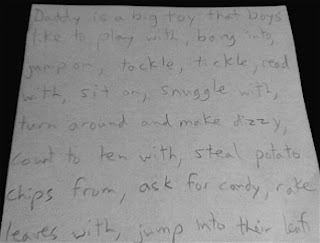
You don't have to be an aspiring writer to try this. My five-year-old handed me a pencil and a half-sheet of unlined paper and told me to write until it was full. He also instructed me to write about a toy. What came out was both fun and heartwarming.
English professors call this "freewriting," and it can be a great way to explore whatever you're thinking about. You write as fast as you can until time is up or you've filled up the paper. The thing I like about it is, it isn't structured at all. You can just unleash. And since you're using pencil and paper, you have that wonderful muscle memory of writing from schooldays gone by, and the potential to doodle, too.
All right, so here's your challenge: Take a pencil and a half-sheet of unlined paper, and write about something that's important to you and one other person close to you. When you've done it, if you'd like to share, post it here or on your own blog or Facebook (and link via the comments section). Ready? Enjoy.
Oh, and here's what I wrote:
P.S. There is no expiration date for this challenge. So whenever you happened upon it, go ahead and give it a try.
English professors call this "freewriting," and it can be a great way to explore whatever you're thinking about. You write as fast as you can until time is up or you've filled up the paper. The thing I like about it is, it isn't structured at all. You can just unleash. And since you're using pencil and paper, you have that wonderful muscle memory of writing from schooldays gone by, and the potential to doodle, too.
All right, so here's your challenge: Take a pencil and a half-sheet of unlined paper, and write about something that's important to you and one other person close to you. When you've done it, if you'd like to share, post it here or on your own blog or Facebook (and link via the comments section). Ready? Enjoy.
Oh, and here's what I wrote:

Daddy is a big toy that boys like to play with, bang into, jump on, tackle, tickle, read with, sit on, snuggle with, turn around and make dizzy, count to ten with, steal potato chips from, ask for candy, rake leaves with, jump into their leaf piles, may [make] snow angels with, throw snowballs at, drive trucks on, steal shoes from, play fire engine with, throw baseballs to, ask for rides in a truck with, ride on back of,Your turn.
P.S. There is no expiration date for this challenge. So whenever you happened upon it, go ahead and give it a try.
John writes mythic fantasy and science fiction for adults and children. His latest story, "Son of Mist," appeared in the April edition of Bards & Sages Quarterly. Check out his webpage for some free stories.
Saturday, September 8, 2012
The form of a fairy tale
.jpg "Grimms' Fairy Tales")
Mark Edmundson defines form as “the primary way that writers infuse
their words with feeling.” A literary work’s form should be “in tune” with the
story’s plot, should reveal and create emotion, and in that sense should reveal
“how it feels to live the author’s truth.” In these senses, Edmundson tells us,
In the music of the lines, in the form, is an entire attitude, a bearing.
What is the “form” of a fairy story? Let me touch the
iceberg here. This is John Ruskin, in “The King of the Golden River”:
And Gluck climbed to the brink of the Golden River, and its waves were as clear as crystal, and as brilliant as the sun. And, when he cast the three drops of dew into the stream, there opened where they fell a small circular whirlpool, into which the waters descended with a musical noise.
It seems to me Ruskin’s music is “as clear as crystal.” It
does not cloak its meaning under metaphor. This is because a fairy story is
already, in some sense, a metaphor writ large. But he does use descriptive
detail in this and other scenes. His description gives a richness and color to
the image I see when I read it. It invites me into nature. The feeling is
there, too. It is a feeling of wonder, evoked by such primal words as “river,”
“sun,” “dew,” and “whirpool.”
Here’s a more “classical” example, a few lines from “Rumpelstiltskin”:
There sat the unfortunate miller’s daughter, and for the life of her did not know what to do. She had not the least idea how to spin straw into gold, and she became more and more distressed until at last she began to weep. Then all at once the door sprang open, and in stepped a little man who said, “Good evening, Mistress Miller. What are you weeping so for?”
Here description has fallen away, and the narrator tells us
only enough to bring us, without damage, to the intrusion of magic into the
tale. The storyteller does build up the girl’s distress, but with a very light
hand. The mundane details—what she was wearing, how she gestured when she
cried, what the room and the little man looked like—are left to us to construe
as we like. And we do like, I think, to construe them in our own minds (or
perhaps not, for not all readers do this).
So here in Grimm we seem to have a simple form, where the
magic is highlighted by the paring away of everyday detail. This
holds true in the rest of the tale, until we come to this episode:
On the third day the messenger came back and said, “I haven’t been able to find any new names, but as I came round the corner of a wood on a lofty mountain, where the fox says good night to the hare, I saw a little house, and in front of the house a fire was burning. And around the fire a most ridiculous little man was leaping. He was hopping on one leg and singing …”
Here the storyteller slows down to give us description. As
in Ruskin’s story, nature is the storyteller’s object, and in a poetic vein.
Something like a metaphor appears in “the fox says good night to a hare,” but
the whole scene is more like an etching than a realist painting. It is the crux
of the story, too, and one can taste the triumph here that will come at the
expense of the little man. Again, primal words like primary colors come at us:
“wood,” “mountain,” “house,” “fire.” The leaping man, the “one leg”—none of
this is wasted. It serves him up for our enjoyment.
“Fundevogel” (a foundling tale) works the same way, but
without any humor at all. Notice how sparse is the introduction of its horrific
theme:
So then the cook said, “Tomorrow morning early, when the forester goes out hunting, I am going to boil the water. And when it bubbles in the kettle, I am going to throw Fundevogel into it and boil him.”
Such sparseness of detail, just as we saw above, is
characteristic of these tales. But it does not diminish the story’s horror; to
me, it conveys it more directly. This is just how it happens in life. I’m not
plagued by a premonition. The clouds don’t darken overhead. I just find myself
in the presence of someone capable of unspeakable evil, realizing it only after
the words have come out of her mouth.
The story is sparse all throughout, almost like a mourner’s
tale. It’s as if the story’s emotion has been stripped out of it. But one small
bit of conversation gets repeated four times.
Lina said to Fundevogel, “Do not forsake me, and I will never forsake you.”
And Fundevogel answered, “I will never forsake you as long as I live.”
This exchange, or some other untold force, allows Fundevogel
to perform magic, which again is described in simple, straightforward language.
The cook, “the witch,” is an embodiment of evil, a threat that comes without
dark clouds or foul weather; the threat is always thwarted by magic, but that
magic comes in response to this deep friendship between Lina and Fundevogel.
Very little description is given in the whole tale, and it loses nothing from
that. The spare sentences again have the effect of heightening the dramatic
action, moving us quickly from one magical intervention to another. The witch’s
frustration is disclosed by her words and demeanor. But the storyteller infuses
the whole tale with feeling only at the point of that repeated vow of undying
friendship. Set against an uninflected narrative voice, that quiet vow speaks
eloquently.
Sources:
Mark Edmundson, Why Read? (Bloomsbury, 2004)
R. L. Green, Modern Fairy Stories (Dutton, 1955)
Grimms' Fairy Tales, translated by E. V. Lucas, Lucy Crane and Marian Edwards (Grosset & Dunlap)
Like this? Come see my new blog, Fairy Spell.
John writes mythic fantasy and science fiction for adults and children. His latest story, "Son of Mist," appeared in the April edition of Bards & Sages Quarterly. Check out his webpage for some free stories.
Saturday, September 1, 2012
Mark Twain on Amateur Authors

In his autobiography, Twain writes:
Not even the most confident untrained soldier offers himself as a candidate for brigadier-generalship, yet this is what the amateur author does. With his untrained pen he puts together his crudities and offers them to all the magazines, one after the other—that is to say, he proposes them for posts restricted to literary generals who have earned their rank and place by years and even decades of hard and honest training in the lower grades of the service.
How times have changed, right? Right. He goes on:
We do not realize how strange and curious a thing this is until we look around for an object lesson whereby to realize it to us.
He proposes: opera. Suppose a man signs up for second tenor
with the opera and (just pretend) suppose he gets the slot without a tryout.
They go to perform.
After the first act the manager calls the second tenor to account and wants to know. He says:
“Have you ever studied music?”
“A little—yes, by myself, at odd times, for amusement.”
“You have never gone into regular and laborious training, then, for the opera, under the masters of the art?”
“No.”
“Then what made you think you could do second tenor in Lohengrin?”
“I thought I could. I wanted to try. I seemed to have a voice.”
“Yes, you have a voice, and with five years of diligent training under competent masters you could be successful, perhaps, but I assure you you are not ready for second tenor yet. You have a voice; you have presence; you have a noble and childlike confidence; you have a courage that is stupendous and even superhuman. There are all essentials and they are in your favor but there are other essentials in this great trade which you still lack. If you can’t afford the time and labor necessary to acquire them leave opera alone and try something which does not require training and experience. Go away now and try for a job in surgery.”
Writing is an art. It requires patient training, lots of
practice, drafts and “workouts” and other sorts of exercises. It requires
patient and careful attention to words, style, narrative. It’s a craft that has
to be learned, that requires, according to Twain, “apprenticeship.” What would
this study “under the masters” look like in this field?
Well, Twain isn’t talking about grad school. Maybe an MFA
gives you a leg up, maybe not. But Twain knew nothing of graduate “creative
writing” programs. As far as I can tell, he knew about “critique groups” only
in the sense that he had others (notably his wife) read and critique and edit
his work. But neither of these is what he had in mind. From what I gather of
his life story, his own journalistic career was a major part of his training.
Getting published in countless brief columns, reporting, working the beat in
California. This went on for years. He then, as he describes it, fell into the
lecture circuit at a time when it was thriving. Writing entertaining lectures
that proved to be successful was, then, another kind of “honest training in the
lower grades of the service.” His first break-out book, The Innocents Abroad, began as reportage from aboard a steamship touring
the Holy Land. He talks, in that book, about how many passengers meant to keep
a journal, and how many succeeded—him.
Something Twain doesn’t mention as clearly, that he might
have taken for granted, and that’s certainly visible in his works, is his
careful, patient reading of literature. For instance, he once found James
Fenimore Cooper guilty of 114 of 115 possible literary offenses (“Fenimore
Cooper’s Literary Offenses,” North American Review, 1895). He praises the literary merits of Kipling’s
works, discusses the stylistic excellence of certain biblical passages, weighs
the literary merits of Ulysses S. Grant’s memoirs, lampoons literary excesses
in pop-fiction of his day. His patient, careful reading and attention to style
are evident in what he produced.
So there you have it: Twain’s recipe for apprenticeship, for
learning from the masters. With some natural ability, hard work, careful
reading, willingness to learn, humble efforts at less-than-glamorous publication,
he promises that “you could be successful, perhaps.” But, as he puts it (and I
paraphrase):
If you can’t afford the time and labor necessary to acquire the essentials in this great trade that don’t result from natural ability, leave writing alone and try something which does not require training and experience.
Does that sting? Maybe you (and I) need a little antiseptic.
John writes mythic fantasy and science fiction for adults and children. His latest story, "Son of Mist," appeared in the April edition of Bards & Sages Quarterly. Check out his webpage for some free stories.
Thursday, August 23, 2012
Rewriting: A Few Thoughts
This past summer, I too (humble me) rewrote a novel that I
originally wrote some fifteen years ago. This is unusual for me. Everything
else that I wrote in that period has long since gone the way of all old
computer files and notebooks. But this story I have rewritten now three or four
times. I keep trying to get it write. (Freudian slip? Let it stand.)
My new tack, this time, was the mantra, “I’m starting to
get bored here.” Wherever the plot dragged along, slogged down, got needlessly
embroiled, I cut to the good thing (the interesting thing) that should happen
next (I knew this, because I had written the story before, you see). I leaped
over earlier drafts’ complications and hindrances – and never looked back.
One thing that helped – trust me, one needs “help” with such
a thing – was the realization that I could just save a new version of the file
whenever I hit that point. Another was that I didn’t try to edit the existing
work, but to rewrite from a blank sheet, with the old draft on the desk at my
elbow. I sometimes typed as much as a page or two without changing a lot. I
called this rewrite “New Try,” and I got up to #7 by the end.
Back to Twain: “In Rouen in ’93 I destroyed $15,000 worth of
manuscript, and in Paris in the beginning of ’94 I destroyed $10,000 worth—I
mean, estimated as magazine stuff. I was afraid to keep those piles of
manuscript on hand lest I be tempted to sell them …”
And here’s another: “In the story of Joan of Arc I made six wrong starts and each time that I offered
the result to Mrs. Clemens she responded with the same deadly
criticism—silence…. When at last I found the right form I recognized at once
that it was the right one and I knew what she would say.”
He says a little later: “To start right is certainly an
essential…. Twenty-five or thirty years ago I began a story… Four times I
started it in the wrong way and it wouldn’t go. Three times I discovered my
mistake after writing about a hundred pages. I discovered it the fourth time
when I had written four hundred pages—then I gave it up and put the whole thing
in the fire.”
Compared to Twain, I know, I have been weak. And that’s not
good. But his courage inspires me. And, as he says, that's what heroes are for: "Our heroes are the men who do things which we recognize with regret and sometimes with a secret shame that we cannot do. We find not much in ourselves to admire, we are always privately wanting to be like somebody else."
John writes mythic fantasy and science fiction for adults and children. His latest story, "Son of Mist," appeared in the April edition of Bards & Sages Quarterly. Check out his webpage for some free stories.
Friday, August 17, 2012
The Great Art of Fantasy
 Mortimer Adler, in his classic "How to Read a Book," suggested five questions to help readers evaluate the artistic quality of a novel (and I quote):
1.
To what degree does the work have unity?
2.
How great is the complexity of parts and elements which that
unity embraces and organizes?
3.
Is it a likely story, that is, does it have the inherent
plausibility of poetic truth?
4.
Does it elevate you from the ordinary semiconsciousness of
daily life to the clarity of intense wakefulness, by stirring your emotions and
filling your imagination?
5.
Does it create a new world into which you are drawn and
wherein you seem to live with the illusion that you are seeing life steadily
and whole?
He writes, “I will not defend these questions beyond saying
that the more they can be answered affirmatively, the more likely it is that
the book in question is a great work of art. I think they will help you to
discriminate between good and bad fiction, as well as to become more articulate
in explaining your likes and dislikes.”
Adler says nothing about fantasy fiction (why would he, writing in 1940?). But his questions four and five would suggest, as J.R.R. Tolkien
claimed, that fantasy done well can be one of the highest forms of literary
art, bar none. (Of course, where it fails, it can also be among the worst.) In
fact, Adler’s questions might even suggest that “literary” fiction succeeds
only insofar as it approximates what Tolkien called “subcreation”—a thing at
which the best of fantasy excels.
After all, what kind of imaginative writing better “elevates
you from the ordinary semiconsciousness of daily life,” especially “to the
clarity of intense wakefulness,” than the kind that takes you out of our own
world to another realm? For it to achieve this elevation, though, the writer's craft has to have that same intense wakefulness about it. It can't be a sleepy hodge-podge of worn tropes, but must select its detail with precision. The best fantasy does this as well as any kind of writing.
For that matter, what kind of fiction creates “a new world
into which you are drawn and wherein you seem to live” more completely than the
kind that requires “subcreation” of a world in the author’s imagination?
In fact, done well, fantasy can also excel at what Adler
calls the “inherent plausibility of poetic truth.” Not factual truth, of
course—which isn’t the point of fiction, after all—but the truth that is deeper
than factuality, that touches the soul.
Needless to say, “literary” fiction (perhaps better termed
“realism” fiction, in this conversation) can attain to high art. Honed language and clarity of thought and expression can bring us into an alternate version of our own world, in which none of the fanciful elements (like magic, or strange geography, or otherworldly creatures) plays a part. This alternate world is so like ours that the reader has no need to learn special rules, except those of the writer's peculiar point of view. But it is, as the life of an imaginary person living in an imaginary society (albeit one very like ours), an instance of "subcreation." It simply doesn't go as far in the process of subcreation as fantasy does. Or maybe we should say that it cloaks its subcreation more intentionally than does fantasy.
Meanwhile, fantasy, rather than cloaking its imaginative work, tends to cloak the similarities that exist between its imagined world and our own.
Both, then--the "realism" fiction and the "fantasy" sort--have the power to bring us out of semi-consciousness to a wakeful state, a new recognition of the world in which we live.
And so, a work in either genre can be termed "a great work of art." At least in Adler's way of defining it.
John writes mythic fantasy and science fiction for adults and children. His latest story, "Son of Mist," appeared in the April edition of Bards & Sages Quarterly. Check out his webpage for some free stories.
Friday, July 27, 2012
On Planning and Not Planning

The other tendency doesn’t want to plan, but to follow an
idea. This idea that teases me, I want to see where it heads, explore it. Like
a trail. I’ve tried this on road trips much less often, but on bike rides and
career paths and hikes, this is how I’ve tended to move forward. The “this
looks interesting, I wonder where it goes?” approach.
I have these two conflicting tendencies in my reading habits
too. There’s the “important that I read it” pile and the “I wonder what this
one’s like” pile. Maybe you have this, too. I have it in spades.
In the experience of writing, I’ve vacillated between the
well-plotted grand design, and the agonizing feel of a blank space, a question
mark, an “I have no idea what happens now.” (This last one is like sitting at a
groundhog’s hole and hoping he comes out. Because if he doesn’t, this will be a
long winter. It takes a lot of faith. And sometimes--though certainly not always--what comes out of the hole
is not worth the wait.)
One of you recently reminded me that in writing, as
in art, there is a place for planning ahead. I’ve tried to reconcile my two
tendencies by using the planning phase intuitively. I use it to explore the
spark that might come out of the idea that’s brewing in my head. I use it to
jot down ideas, to sketch out possible trajectories, to feel after a character.
I might list what I know about him or her and what questions I have about him
or her—including how she’ll turn out.
For me, it’s critical not to let this go too far. My lengthy
three-volume epic that I once outlined (while working in a factory, I might
add) never came to fruition. Worse, I never started it. Partly, I lost interest, and partly I got overwhelmed. I have to be careful not to expend my creative energies for
this or that story in the planning phases. If I do that, I’m sunk. There’s no
juice in the tank for bringing it to life. (For the same reason, I don’t much
talk about ongoing story projects. Early advice I’ve found helpful.)
What’s more, for me it’s important that I let the characters
take me to places I didn’t know they had in them. I figure that I know these
characters (I’m tempted to say “people”) better after I’m knee-deep in their
story than I did when I was just thinking about them from afar. (Though I
sometimes go back to an early spark to correct a misread of character or
direction, too.) As for secondary characters—the friends and colleagues and
minor (and sometimes major) enemies that will crop up in the story—for me these
must happen as the story invites them in, or as they bully their way in. I
think a lot of writers will tell you that: some characters write themselves
into the story. Almost all my secondary characters do something like that. They’re there in
the path or even the psyche of the character whose tale this story primarily
tells. But they too are real, moved by their own mysterious motivations. No one
sits idle, a piece of furniture. Everyone, like the real people you know in
life, has a story, an angle, wishes, dreams, despairs—even if they seem ever so
pedestrian to you and me.
All this to say, I suppose, that planning a story (or a work of art, or a life's journey) shouldn't be allowed to take the place of the story (or life) itself. If it serves that end, all to the good. If not, let it go.
John writes mythic fantasy and science fiction for adults and children. His latest story, "Son of Mist," appeared in the April edition of Bards & Sages Quarterly. Check out his webpage for some free stories.
Sunday, July 1, 2012
Intuitive Writing
Serendipity? Not long after I wrote my last post, Terri Windling posted an eloquent testament to the intuitive approach to creating art
– visual, narrative, poetic. (If you'e not seen it, jump over there for a wealth of insight and inspiration. Trust me, it's rich.) That discussion has inspired me to reflect a bit more on
the theme.
I remember a time when I felt guilty, actually guilty, that
I wasn’t “doing my homework” when I wrote stories. I’d been told to plan out my
stories in advance, write outlines, give my characters little biographies, work
up a complex portrait of scene and society. All that before you write – so I’d been told.
This advice came via all sorts of channels, mostly writing guides. But it also
seemed to be what one my literary heroes, Dostoevsky, did – as far as I could
tell from reading the introductory articles to his works. (I now think his
approach was more intuitive than I then supposed.)
Still, I persisted in being “lazy,” jumping into my stories
with almost no idea what would happen, hardly a clear idea of who was who, and
at most a vague sense of where the story might go. All I knew was a dilemma or
an idea, a concept of some kind. My excuse was that I didn’t have time to do
all that other work. That if I did that, I’d never get a chance to write the
story, explore the idea. But the deeper reason was that I just didn’t want to
do it. It evoked from me a deep, internal “uggh.”
Only slowly have I come to see that this is not a bad thing.
As I mentioned in my last post, I came across the other sort of advice later in my
apprenticeship. I’ve eavesdropped on artists I admire, and found out they do
what I do – that they loathe the notion of planning all this out in advance.
That it empties the work of its joy, and saps the potential of the story itself,
or their creative process. So I gave up that guilt and just started writing.
And then something happened. I had a novel that I’d
rewritten a couple of times, and on the last rewrite a character had emerged
out of the woodwork into the story and, despite almost no presence on the page,
had played a vital role in its unfolding. And one night, though I can’t swear
it kept me up, she nagged at me. She wanted me to tell her story. I thought,
“This is silly. It doesn’t make sense to write the story of a minor character
in an unrevised novel.” But … well, she kept nagging, in an intriguing sort of
way. So, to appease her, I jotted down some four or five lines, sketching out
what I knew about her and what I didn’t. It turned out that I knew quite a bit
more than I suspected, but I put it aside, still thinking it was foolish to
obey this impulse.
Then, a few days later, I opened up that little document,
about as close to an outline as I’d ever gotten, and I wrote about two
paragraphs in her voice, coming from the point in the story where she awakened
from her own hardship into hope. And that cracked open my resistance. The whole
story was there. It was simply a matter of finding out how we got to that
tangled knot, and how it would untangle for her.
I wrote it, thinking it was awful. I almost gave up, then
went back and glanced over some earlier pages – realized it wasn’t awful. After
that, I wrote it with fear that I would destroy what had begun. And then
gradually I just gave up my fear and prejudice and reservations, and I wrote
her story with a kind of astonished, listening ear.
If any of my novels makes its way before you, I hope it’s
this one. Later this summer I plan to send out her story. But if no one notices
her, at least I did. And I feel a kind of awe and pride in having done so.
Like this? Come see my new blog, Fairy Spell.
Like this? Come see my new blog, Fairy Spell.
John writes mythic fantasy and science fiction for adults and children. His latest story, "Son of Mist," appeared in the April edition of Bards & Sages Quarterly. Check out his webpage for some free stories.
Tuesday, June 26, 2012
Two Kinds of Writing Advice
As a writer, I've been on the receiving end of plenty of
writing tips, strategies, how-tos, and how-not-tos. Looking back at this wealth
of opinion on how to craft good stories, compelling characters, believeable
worlds, etc., I see some patterns. In particular, two overarching approaches to
writing stand out: the blueprint approach and the intuitive one.
Let me preface this post by saying that writing advice was
important to my growth as a writer. When I was learning the craft (and when
aren’t we?), I plowed through a lot of how-to manuals (I still pick at them). I got my Writer’s Market and read all those
articles (well, almost all of them). I checked out volumes from the library and
worked through them. I wouldn’t go back now and undo that—even for the advice
I’ve rejected. When I started reading advice, I’d already written a lot of stories, and
these manuals taught me about revisions, preseverence, inspiration, what works
and what won’t, and more. The more advice you can get when you’re starting out,
the better.
But after you read a lot of writing advice, you realize that
some kinds of advice work better for you than others. I suspect other beginners
have experienced this. I’ve identified two general approaches, and I’ll first discuss the one I encountered first. Since I was working especially on “how to
write fantasy,” and especially novels, I’ll focus on that kind of advice.
1. The blueprint approach. The first approach to “how to
write a fantasy novel” is to tackle the pieces, or elements, of the novel.
These would include the world in which your story takes place (including the
type of magic in that world, and its role in that world), the characters and
their personalities (plus what kinds of creatures will exist in your world),
the dilemma those characters must face, the way that dilemma unfolds (the plot),
and such smaller pieces as “scenes” that occur in the larger story arc.
Proponents of the blueprint approach often advise us to
build exciting, interesting, and believable worlds, populate them with exciting
and interesting characters (not too perfect), and throw them into a situation
that is also exciting and interesting. They might tell us how to construct a
kick-ass plot line, how to make dialogue zing, and how to give depth to
characters. If you follow their advice, you can (perhaps) build something
readable or at least something halfway there.
2. The intuitive approach. The second approach begins from
the other side, so to speak. If the first approach builds the story like a
house, the second feels its way into it by a door or window (or perhaps a crack
in the foundation). In the second approach, there is a house but no blueprint,
because the writer does not know where she or he is going. Probably the most
widely read description of this approach is Stephen King’s On Writing. King disavows plots altogether, claiming he is not (nor
does he ever desire to be) a plotting person. He starts with an idea (an
intuition), a new combination of two things, and he describes the unfolding of
the story as a discovery, not a construction project.
But other writers say similar things. Ursula LeGuin informs
us that she did not know what existed on the islands of Earthsea until she
“went there” with her characters. She too seemingly intuits, discovers through
writing. Jane Yolen tells us that she writes like a reader, not knowing what
will happen next (and interested to find out).
This intuitive approach to writing is less commonly
encountered in how-to guides, and for an obvious reason: it’s hard to give concrete advice about
following your intuition. (Though Stephen King did a pretty good job.) What’s
more, writers who take this approach tend not to gravitate toward “how-to”
thinking in the first place. They aren’t blueprint sorts of people.
Which brings me to the impetus behind this post,
and its final point. If, like the second group, you’re an intuitive,
idea-oriented person, you’ll probably find the blueprint approach mechanical,
devoid of excitement, turning the writer into a typewriter. If you’re the
blueprint sort, you’ll probably find the intuitive approach overwhelming,
lacking focus or direction, confronting the writer with an intimidating blank
page.
The point is, then, to discover which kind of writer you
are. I wish I had known sooner; I would have spent less time trying to pinpoint
the exact beginning and end of a scene in my novel, and more time thinking
inside the scene. Maybe this post will help you avoid a similar pitfall.
John writes mythic fantasy and science fiction for adults and children. His latest story, "Son of Mist," appeared in the April edition of Bards & Sages Quarterly. Check out his webpage for some free stories.
Wednesday, June 6, 2012
Ray Bradbury Tribute - In his own words
I never met him, except where we all met him: In his books
and stories. Here are some things he said about his own life.
“In my later years I have looked in the mirror each day and
found a happy person staring back. Occasionally I wonder why I can be so happy.
The answer is that every day of my life I've worked only for myself and for the
joy that comes from writing and creating. The image in my mirror is not
optimistic, but the result of optimal behavior.”
“I like to think of myself on a train going across America
at midnight, conversing with my favorite authors”
“All my life I’ve been running through the fields and
picking up bright objects. I turn one over and say, Yeah, there’s a story. And
that’s what kids like. Today, my stories are in a thousand anthologies. And I’m
in good company. The other writers are quite often dead people who wrote in
metaphors: Edgar Allan Poe, Herman Melville, Washington Irving, Nathaniel
Hawthorne. All these people wrote for children. They may have pretended not to,
but they did.”
“Every so often, late at night, I come downstairs, open one
of my books, read a paragraph and say, My God. I sit there and cry because I
feel that I’m not responsible for any of this. It’s from God. And I’m so
grateful, so, so grateful. The best description of my career as a writer is “at
play in the fields of the Lord.” It’s been wonderful fun and I’ll be damned
where any of it came from. I’ve been fortunate. Very fortunate.”
“Action is hope. At the end of each day, when you’ve done
your work, you lie there and think, Well, I’ll be damned, I did this today. It
doesn’t matter how good it is, or how bad—you did it. At the end of the week
you’ll have a certain amount of accumulation. At the end of a year, you look
back and say, I’ll be damned, it’s been a good year.”
Good work, Mr. Bradbury.
John writes mythic fantasy and science fiction for adults and children. His latest story, "Son of Mist," appeared in the April edition of Bards & Sages Quarterly. Check out his webpage for some free stories.
Monday, May 7, 2012
On Writing Through
I’m in the middle of a story that, for a variety of reasons,
has been hard going. I’ve had a sense that something might be coming (in the
story) that I won’t like. Or that I won’t want to face. Who knows? I’ve also
had trouble finding time, the kind of mental space that’s necessary to face
something difficult.
For me, difficult emotions have a way of crowding out
everything else, including the desire to “work.”
One solution—constantly tempting—has been to just put the
story aside and do something else. As writing goes, though, I’ve been down this
road before, and I don’t believe it can bring me to a good outcome. Putting
something aside means coming back to it—if ever—when you’re a different person,
usually more than a year down the line. Your interests have changed; your
worries too; sometimes even your style of writing has changed, be it ever so
subtly. You come back … and you write it differently than you were writing it,
and differently than you would and even should have, when you needed it most.
Not that there aren’t writing projects that should be put
down. I mean, in the sense that you put down a horse. This isn’t one of those.
It’s not misguided, at least in terms of my own artistic sense, whatever that
is.
No, this is just one where I say: Am I going to face this,
whatever is holding me back? Or am I going to turn away from it? And that’s a
decision that a writer has to make, about how and who he or she wants to be, as
a writer. For me, I’ve long since opted out of writing for any other reason
than precisely this kind of soul-searching.
So if I’m going to grow as a writer, and as a human being, I
need to press through this, whatever it is. I need to write my way through it.
And really, deep down, I want to do that. I have enough faith in this process
to know that it’ll be worthwhile. I’ll come out okay, and maybe more than okay.
I just need a little patience, and that old-fashioned virtue they call
perseverance.
Which reminds me of something else I was going to do …
John writes mythic fantasy and science fiction for adults and children. His latest story, "Son of Mist," appeared in the April edition of Bards & Sages Quarterly. Check out his webpage for some free stories.
Tuesday, April 17, 2012
My First Journey to Mars
For several weeks, I’ve been trying to remember how it
happened that my first-ever novella was firmly in the science fiction genre.
The year would have been 1984 or 1985. Let me describe the story for you:
An astronaut, haunted by dreams of
his own death, agrees to go through with a scheduled mission to Mars. Once
there, he somehow wanders from the space craft and is lost. Instead of dying,
however, he finds himself among a colony of Martians, who live underground. (In
my memory, the place is sort of hellish, but I could be misremembering this.)
After spending some time among the Martians, our astronaut somehow makes his
way out of the Mars camp, or at least makes contact with earth. His time among
the Martians somewhat mirrors first contact between Europeans and Native
Americans, though without the exploitation. (At least that was how I envisioned
it, though I never finished that part.)
You’ll see that it’s pretty standard fare for sci-fi. The
strange part, though, is that I hadn’t read any “standard fare” sci-fi. I’d
never read H. G. Wells, or Jules Verne, or Ray Bradbury, or (as far as I can
remember) any science fiction at all. (I know I did read Orwell’s 1984 that year for school.) I must have watched enough
television, although this was very limited in my household. Even so, I’m sure
by then I’d seen sci-fi movies. For instance, I saw The Last
Starfighter in 1984. I saw Star
Wars (only the first one) a couple of years
earlier (on VHS). No doubt I’d seen “Star Trek” reruns (not yet the movies, I
think), and possibly some others I can’t track down.
I gave up the story unfinished, because I either got
distracted or couldn’t get the middle to work out. I had several competing
drafts, and had started in the middle. I don’t think it was even the only story
I was working on at the time. Some things never change …
I don’t remember this, but I’ve rediscovered that NASA had
sent two space probes to Mars (the “Viking” probes) when I was about five years
old, with the hope of (and equipment for) discovering life on Mars. Maybe I’d
learned about it in science class, connected that to my American history, threw
in a little T.V. or movies and—voila! My own first unfinished novel.
I wrote it in study hall.
This has me thinking about the old adage that you have to
read a lot in a particular genre to write something worthwhile in that genre,
and the somewhat competing adage to be careful not to imitate what’s selling,
or it will be soulless. (I might have made that second one up.) My story falls
between those two adages. It wasn’t good, but then again I wrote it when I was
thirteen or fourteen. The reason it wasn’t good, was that I didn’t know how to
write. Everything I did was pretty much straight imitation. That, and the idea
wasn’t one I’d pursue now. But I can imagine this idea or one like it being
done well, if the writer knew what he/she was doing. In fact, this story (it
seems to me) shares elements of Event Horizon, a 1997 film, the novel Dream Thief by Stephen Lawhead (written in 1983, but not read by
me until a decade later), and The First Men in the Moon by H. G. Wells (which I read about five years ago).
So, the plot itself isn’t a terrible one, nor is it so
overdone that it couldn’t catch someone’s interest—in 1985, I mean. One of the
reasons for that, I suspect, is that I was probably as much influenced by Robinson
Crusoe, which I read in sixth grade, as I
was by the sci-fi “genre” itself. Which makes me think that reading “in genre”
isn’t as important as reading classic literature. Or at least not more
important than. I’m open to other opinions.
Sadly (ahem), the manuscript is lost, I do firmly believe.
John writes mythic fantasy and science fiction for adults and children. His latest story, "Son of Mist," appeared in the April edition of Bards & Sages Quarterly. Check out his webpage for some free stories.
Subscribe to:
Posts (Atom)
LinkWithin
