Yesterday I had an eye appointment. It had been three years, but my prescription was fine, my eyes in good condition. I'm thankful.
I'm thankful because the woman at the counter asked me, not where I was employed, but whether. And I could answer "yes."
I'm thankful because after somehow reaching my home safely despite the eye drops, I couldn't think of what to do. I couldn't read. I couldn't work a puzzle. Couldn't go outside (too bright) to fiddle in the garden. So I'm thankful that I have vision.
I guess I wasn't always that way. As a boy, I didn't want to wear glasses. So I hid the note the school nurse sent to my parents. Destroyed it, more like--and suffered for another two years. I remember using the complex refracting properties of my fingers and eyelashes to read the chalkboard. This must be how people used to do it, before they invented glasses.
Then--well, I thought maybe I should experience some kind of miracle. Raised with faith-healing on television and in revival meetings, I decided that my eyes warranted divine intervention. So I prayed, and then when it didn't happen, I felt guilty. And then when I was tired of that, I sulked.
Somehow it took me another thirty years to discover that the miracle was there all along. I can see! With lenses, I have 20/20 in both eyes. What a gift that is. And this morning, even though my eyes ache a bit from the drops and the torment the doctor put them through, I'm not taking for granted the sight of sunlight on the green leaves of the dogwood, or the flicker of green lights on my router, or the ability to read what I've just written.
When I finally got the glasses, the first thing I noticed were the gray hairs on my mother's head. I was young and dumb enough to say that out loud. But in a sense, gray hair is also something to be thankful for. I should know; I've got some of that, too.
Showing posts with label family. Show all posts
Showing posts with label family. Show all posts
Wednesday, May 22, 2013
Vision Care - with gratitude

 John writes mythic fantasy and science fiction for adults and children. His latest story, "Son of Mist," appeared in the April edition of Bards & Sages Quarterly. Check out his webpage for some free stories.
Thursday, April 18, 2013
The Saturday of Spring
You know it's been a rough spring when your baseball team is 10-4 and you haven't watched a single inning, haven't looked at a single box score, don't know who's new on the roster, couldn't name three players still on the team with any conviction at all.
Such has my spring been. The grass in the back yard--did I say grass? I meant clover--is mid-calf. The squash I planted in the greenhouse has grown to monstrous proportions, and yet I haven't started peppers. I haven't mended the garden fence, which I destroyed after seeing deer in the yard. I haven't even bought the supplies to do it.
Ironically, part of the blame falls to baseball. I have two boys now in the littlest leagues, one still hitting off a tee and daydreaming on the infield, and the other hitting real pitches hard (sometimes) and trying his darnedest to throw like a man. Fabulous quantities of practices so far, with the game schedule creeping inexorably toward us. If you've been there, you know. I won't see a clear Saturday until June.
Ah, Saturday. You my lost friend. Leisurely time to mow the lawn, mend the fence, hack at old tree stumps, light a pipe, whittle, toss a ball … Will I never know you again? The quiet Saturday of Spring, the dull chatter of baseball announcers, the hum of the crowd in the background, the exaggerated crack of the ball in the mitt or on the bat, the roar of the Fenway faithful as the ball soars out toward the Green Monster.
So that's what I'm missing. Time to kill. The leisure of a game that says, "Hey you! Slow down and watch this pitch. Nothing may happen. Or everything may happen. And there will be three hundred of these pitches today, over the next three hours. And you will watch every one of them. And feel not one ounce of guilt."
As I said, it's been a tough Spring.
John writes mythic fantasy and science fiction for adults and children. His latest story, "Son of Mist," appeared in the April edition of Bards & Sages Quarterly. Check out his webpage for some free stories.
Thursday, March 14, 2013
Gunmen in the Park
The last words you want to hear at a public park, out with your children, especially these days: "Put your hands in the air."
It took me a moment to register this. I'd heard the sirens--they aren't that uncommon--and I'd been watching my boys play on the "fort" some fifteen feet away. The policeman's voice came from over my shoulder, and I turned my head to look.
"Hands where I can see them," he repeated. The officer was big, and more sirens were screeching behind us. I followed his gaze and then I saw them. My children were between me and three young men in black and fatigues, standing with their arms raised. I stood and walked to the play set.
"Boys, come on down from there," I said, calmly. Maybe too calmly. I didn't want to scare them. But the park, a bustle of happy cries a moment before, had gone quiet as a museum. My boys were transfixed, too. Then my youngest slid down, while the other stood his ground, watching it unfold.
"Come down. Hurry up," I said. The reality of the situation was starting to set in. The tallest two youngsters, boys really, wore long black trench coats, and they were not thirty feet away. And my oldest was still between me and them. I tugged him off the play set, corralled his younger brother, and crouched down behind the laughable protection of a chain ladder countless children had used to climb into the "fort."
The police officer had raised his voice again and he was now nearer the youngsters. I don't remember that he had a gun drawn. I don't remember a taser. I do, though, remember the moment he reached them and took their guns. They were long, assault-rifle-looking guns. And he said something like, "You scared people."
 |
| Image from http://moretoyguns.com/MoreToyGuns/product/4GUNDT.html |
It took a long time for the situation to dissolve, though, I do know that. The police cars sat for several minutes with their flashers pulsing, and more still without them. The arresting officer took the young men behind a building and, presumably, to his cruiser parked out of sight. He was carrying their guns, and I was left with the boys, wondering how soon was too soon to let them play normally.
Meanwhile, as I held on to them, reassuring them, explaining that it was only a mistake, keeping my voice steady because … oh my God, it could have been something a lot worse … I realized something I hadn't before: only after the crisis had passed did I understand what could have happened. Like most people, I assume more innocence in the world than evil, even after all I've watched unfolding on the news. I just don't have it in me to expect mass murder. Neither did anybody I saw in the park that day. Nobody fled in a panic. And I can't say I'm sorry for that. In fact, I think it's those of us who don't expect it or think it's normal who will ultimately press for the real changes that are needed: an end to bullying, an end to hate-speech, to stock-piling and paranoia, to the glorification of violence. Sensible gun regulations. Kindness in public places. Care for outcasts. These are the kinds of changes that could make for a world where I won't have to do more than I did in the park that day.
And, as it turns out, when you think about it, I was right, wasn't I? Those boys weren't bent on killing us all, now were they? So maybe believing the best about people isn't such a bad place to start after all.
John writes mythic fantasy and science fiction for adults and children. His latest story, "Son of Mist," appeared in the April edition of Bards & Sages Quarterly. Check out his webpage for some free stories.
Sunday, February 24, 2013
The First Day of Spring came in February
Calendars notwithstanding, today was the first day of Spring.
Proof:
Most of all: I wanted it to be Spring. And so did my sons, and my wife, and the birds, especially the one that sang outside my bathroom window this morning. Him especially. He was dying for Spring to be here. No, not dying. He was announcing its arrival.
Proof:
- my son found a flower growing in the yard
- I went on a bike ride with my son
- I was hoeing in my garden, and red potatoes I had planted in the Fall came out, like little eggs given to us by the Easter Bunny
- I grilled hamburgers for lunch (check and mate!)
Most of all: I wanted it to be Spring. And so did my sons, and my wife, and the birds, especially the one that sang outside my bathroom window this morning. Him especially. He was dying for Spring to be here. No, not dying. He was announcing its arrival.
One must always listen to birds in these matters. They know.
So Happy Spring, if you're lucky enough to live where it came today. And if not, if you're still in winter, hold on. Your hope is soon to be rewarded. Or if you're in summer, rejoice with me, because today Spring came.
It's here. Everything is new again. Bright with promise. And the garden awaits me, its soil dark and damp. Life will come up through the earth, weeds will sprout, trees will bud, birds will ta-ta-tap at my house, bees will eat holes in my porch ... All this is upon me. And this week, with any luck, I'll get the first seeds into the potting soil, and I'll start my plans, ever elaborate and full of schemes, ever derailed by life and accidental seedling deaths -- but not yet. Today all is fresh and green and blooming in my mind. The broken-down garden fence calls to me, pushing aside the last of my winter chores. The rain gutters need my care. My bicycle chain needs oil. My legs need stretching. I'm dreaming of hiking in the woods. I'm gazing at this and that, thinking of paint and hammer and nails. I'm a homeowner astir. I'm a beaver come out of the winter chill.
Yes, Spring is here. I know it in my bones.
John writes mythic fantasy and science fiction for adults and children. His latest story, "Son of Mist," appeared in the April edition of Bards & Sages Quarterly. Check out his webpage for some free stories.
Friday, February 15, 2013
Meeting Brer Rabbit
When I was a boy, my father, who was always too busy, would sometimes refer to (but not tell) stories of Brer Rabbit. I suppose, in retrospect, he didn't remember the actual stories, just the gist. Or maybe he feared he wouldn't get the dialect right.
Even so, it awoke in me a thirst to meet this compelling creature, and find out about his mischievous deeds. I did, too, many years later--perhaps as many as thirty years, to be exact.
It happened like this: I had a gift card for a bookstore. A friend, apologizing needlessly for the "lack of thought," had sent me something I would actually use and that felt like a luxury. I used most of it to buy a hardcover edition of The Hobbit, to replace the old paperback that I had foolishly tossed out in a move. (Well, donated to the library ...)
Then, a couple of weeks later, or perhaps a month, I was back at the bookstore with my youngest son, then four years old. He liked to play with the train set they keep in the kids' section of the store. So I went back with him and started browsing the kids' books. You maybe haven't looked in a while; I hadn't. There were depressing quantities of "series" and relatively few stand-alone books. Shelves and shelves and shelves of these series, all with look-alike spines. And then in one corner, half a shelf or so, some "fairy tales."
 |
| This is my shelf, but you get the idea. Can you spot Uncle Remus? |
I snooped through them. Most were reproductions of classic tales. But tucked among them, small, in a yellow cover, with a reddish-orange spine, there it was:
JULIUS LESTER The Tales of Uncle Remus PUFFIN.
I took it off the shelf. You know the feeling: a little tingle goes up your arm. The book has a bit of magic in it. It's been waiting for you. I get that sometimes at the library. Only this time, it could be mine.
The front cover:
PUFFIN MODERN CLASSICS
THE TALES
OF UNCLE REMUS
The Adventures of Brer Rabbit
AS TOLD BY JULIUS LESTER
ILLUSTRATED BY JERRY PINKNEY

I flipped to the introduction. The LAST thing I wanted was a bowdlerization of a set of tales I'd heard of (but never heard) my whole life. But then again, it was Puffin … A charming introduction by Augusta Baker, dated 1985, calmed my fears. I read part of a story (to the tune of my son's choo-choo). And that was that. I took it to the register and handed it to the clerk.
"Someone's getting a treat," she said, looking at my son.
"Well, we both are," I said, with a shy smile.
I took out my gift card, depleted the last penny of my balance, added a couple of bucks, and it was mine.
Postscript: I read these tales to my boys, with much pleasure, over the course of the next couple of months. I followed it up with a free iBook collection of original Joel Chandler Harris tellings. I like those old ones, yes; but Lester's renderings have a soft spot with me.
John writes mythic fantasy and science fiction for adults and children. His latest story, "Son of Mist," appeared in the April edition of Bards & Sages Quarterly. Check out his webpage for some free stories.
Tuesday, January 1, 2013
This Year - A Few Highlights
Here are some highlights of year 2012. (I'll keep it brief.)
I published my first story, “The Unicorn Hunt” and had a
second (“Stonepit”) accepted into an anthology (I’ll keep you posted when it
comes out).
I sent out about 10 stories, some more than once. That
includes the two above (and two mentioned below).
I did a fair amount of writing. By my count, I wrote (at
least in first-draft form) nine short stories. I rewrote (yet again) my first
and still most maddening fantasy novel, Foldwin the Shepherd. I wrote and lightly revised a very short novella,
with the working title A Dryad Dream.
And I finished and edited (first round) a new novel, tentatively entitled Unfoldings. Whew. And I had thought it was an off year.
I went on at least three awesome hikes with my wife and boys
here in North Carolina. I also took them fishing, and my youngest caught his
first ever fish.
I broke down and bought an iPad. I also broke down and got a Twitter handle (@pylefantasy). Those things aren't related, I swear it.
I discovered a fascination with Middle Grade fiction. The
Tale of Despereaux was an ally in this.
I took a sudden and powerful interest in my family tree.
I’ve made astounding progress tracing it back, in some cases into the sixteenth
century. All this from scratch as of April.
As an outworking of that, in October I made a meaningful
trip to Tennessee, to the gravesite of my ancestor Conrad Pile. Saw the valley
where he settled down, among the first to till the land there.
I don’t mean to make it sound like there weren’t any bumps
along the way. But I like to lift out the good days, don’t you? What
highlights, celebrations, joys, for you this year past?
John writes mythic fantasy and science fiction for adults and children. His latest story, "Son of Mist," appeared in the April edition of Bards & Sages Quarterly. Check out his webpage for some free stories.
Saturday, December 22, 2012
A Christmas Meditation
The Christmas season has an amazing store of joy that it can, and often does, shower on the head of the unsuspecting. A little hand gripping your hand to tug you toward a glittering Christmas tree. A few flurries in a strangely warm winter. Hugs from kindergarteners happy that you're playing them a song for their school party. Sweet cookies around the table with friends.
 And then, meanwhile, there is the misery of shopping. The unfathomable crowds inside and lines of cars outside. The disgruntled faces at every turn. The look of frustration that I know mirrors my own as I apply strange quantities of pressure on myself to find "the perfect gift."
It occurs to me that there's an inverse relationship between these two things. That the more I get caught up in the shopping, buying, surprising, driving, competing ... the less I glimpse the simple, clear joys of the season.
Those joys are childlike things. To see the season from the eyes of an innocent wonder: that's the secret, I think. And heaping piles of stuff somehow deadens that wonder.
It's not all that different from life, is it?
So here's to keeping an eye out for the joy, friends.

It occurs to me that there's an inverse relationship between these two things. That the more I get caught up in the shopping, buying, surprising, driving, competing ... the less I glimpse the simple, clear joys of the season.
Those joys are childlike things. To see the season from the eyes of an innocent wonder: that's the secret, I think. And heaping piles of stuff somehow deadens that wonder.
It's not all that different from life, is it?
So here's to keeping an eye out for the joy, friends.
John writes mythic fantasy and science fiction for adults and children. His latest story, "Son of Mist," appeared in the April edition of Bards & Sages Quarterly. Check out his webpage for some free stories.
Sunday, December 16, 2012
Remembering my ancestors
 |
| Bath time for (baby) grandma |
Today, lacking a ritual that satisfies that need without offending my own religious scruples, I have found that tracking my ancestors' movements brings to life something of who I am.
And that, in some ways, must have been what ancestor worship was all about: a way to know your place in the world. After all, social groupings seem so arbitrary. Circumstances of birth, property inheritance, marriageable persons within a reasonable distance from home ... these all seem incredibly--really incredibly--arbitrary. We have no control over any of them, and, what's worse, they seem so strangely random. Like the personalities of your siblings. How can one find meaning in any of this?
But the story of the dead; of where they went and what they did; of their wars and their courage; of their breaking new ground and migrating across continents--these are somehow meaningful to me. I watch my ancestors, as it were, cross oceans, found villages, set up churches, marry and move. And now and again, someone stands out as almost heroic in the herd: a man or woman who does something really noteworthy, whether for good or ill. And I begin to understand: maybe I really am connected with the world around me. Maybe I really do belong where I am. Maybe there is meaning in the circumstances of my birth, my wiry frame and personal traits, my siblings and the gifts I have inherited.
So yes, in a way, genealogical research is like ancestor worship, in the sense that it fills the same void. It gives honor to those who have died, without covering over their blemishes, except in the way that such things become lost to later generations. It honors how they have shaped me. That I am not alone. I am like others around me; and also, in some way, these others have left a trace of themselves in me.
John writes mythic fantasy and science fiction for adults and children. His latest story, "Son of Mist," appeared in the April edition of Bards & Sages Quarterly. Check out his webpage for some free stories.
Friday, November 30, 2012
Ode to Teachers
You teachers of the young,
we their parents thank you.
Not in paltry sums of money,
though our taxes give you that,
but in our better, deeper hearts.
You tame the wildness of our children.
You temper their devilish ways.
You hold them in straight lines
and within dotted lines,
which we can never achieve in a hundred afternoons.
You make them read, when we are busy reading.
You make them ask questions we would shun to answer.
You mold of them persons suited to learning,
who showed us few signs of teachability.
Countless hours you spend crafting
words and activities to guide our young,
on paths of gradual difficulties,
while we plan nothing, taking what they give us,
and expecting behavior we ourselves struggle to exhibit.
Therefore you have the stronger influence
over their minds and their discipline.
With godlike patience you teach them letters,
numbers, sums, and fractions,
while juggling the demands of a fickle government
and a still more fickle public,
that too often undervalues the supreme value
of your ceaseless labor, your long hours
and small payment, and smaller esteem.
Better than most of us, you see the value
in our children, you turn from the goods
of a more lucrative life, you weed and trim
the small saplings, knowing (when we forget)
that of these seedlings, great trees are made.
For all this and all that I have left unsaid,
the joy you feel when our children succeed,
the pain you feel when they fail,
the heartache it gives you when we fail them,
the love you bear them in countless small gestures,
for all this and all that I have yet left unsaid,
we their parents thank you.
© John Pyle, 2012
John writes mythic fantasy and science fiction for adults and children. His latest story, "Son of Mist," appeared in the April edition of Bards & Sages Quarterly. Check out his webpage for some free stories.
Friday, November 23, 2012
An Inspiring Writing Challenge for Everyone
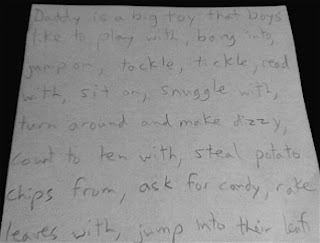
You don't have to be an aspiring writer to try this. My five-year-old handed me a pencil and a half-sheet of unlined paper and told me to write until it was full. He also instructed me to write about a toy. What came out was both fun and heartwarming.
English professors call this "freewriting," and it can be a great way to explore whatever you're thinking about. You write as fast as you can until time is up or you've filled up the paper. The thing I like about it is, it isn't structured at all. You can just unleash. And since you're using pencil and paper, you have that wonderful muscle memory of writing from schooldays gone by, and the potential to doodle, too.
All right, so here's your challenge: Take a pencil and a half-sheet of unlined paper, and write about something that's important to you and one other person close to you. When you've done it, if you'd like to share, post it here or on your own blog or Facebook (and link via the comments section). Ready? Enjoy.
Oh, and here's what I wrote:
P.S. There is no expiration date for this challenge. So whenever you happened upon it, go ahead and give it a try.
English professors call this "freewriting," and it can be a great way to explore whatever you're thinking about. You write as fast as you can until time is up or you've filled up the paper. The thing I like about it is, it isn't structured at all. You can just unleash. And since you're using pencil and paper, you have that wonderful muscle memory of writing from schooldays gone by, and the potential to doodle, too.
All right, so here's your challenge: Take a pencil and a half-sheet of unlined paper, and write about something that's important to you and one other person close to you. When you've done it, if you'd like to share, post it here or on your own blog or Facebook (and link via the comments section). Ready? Enjoy.
Oh, and here's what I wrote:

Daddy is a big toy that boys like to play with, bang into, jump on, tackle, tickle, read with, sit on, snuggle with, turn around and make dizzy, count to ten with, steal potato chips from, ask for candy, rake leaves with, jump into their leaf piles, may [make] snow angels with, throw snowballs at, drive trucks on, steal shoes from, play fire engine with, throw baseballs to, ask for rides in a truck with, ride on back of,Your turn.
P.S. There is no expiration date for this challenge. So whenever you happened upon it, go ahead and give it a try.
John writes mythic fantasy and science fiction for adults and children. His latest story, "Son of Mist," appeared in the April edition of Bards & Sages Quarterly. Check out his webpage for some free stories.
Friday, October 26, 2012
A Visit to the Old Country
Turns out I have roots in Tennessee. About two weeks ago, I made a little pilgrimage to the old country. It was a surreal experience.

Here I am, standing at the grave site of my ancestor, Coonrod Pile. In the distance, of course, is one of the seven mountains that surround the beautiful, peaceful valley of Pall Mall, Tennessee, birthplace and home of Sgt. Alvin York, the war hero. Alvin York was the great-great-grandson of Coonrod, who helped settle the valley in the 1790s.

Here's the plaque beside the grave. Coonrod and his wife Mary are buried side by side there, with a daughter. The "Three Forks of the Wolf" refers to the river that flows through the valley. Below is a shot of it, from the suspension bridge you cross to get to from Alvin York's house to the gravesite.

You probably can't tell how green the river is. It's quite lovely.
From this place - not a place like it, but from this very place - one of my ancestors set out in search of his own farmland, though his daddy was rich: I mean Coonrod Pile's son Daniel. He made his way to Indiana then Illinois. It was very moving to retrace his steps.

Here I am, standing at the grave site of my ancestor, Coonrod Pile. In the distance, of course, is one of the seven mountains that surround the beautiful, peaceful valley of Pall Mall, Tennessee, birthplace and home of Sgt. Alvin York, the war hero. Alvin York was the great-great-grandson of Coonrod, who helped settle the valley in the 1790s.

Here's the plaque beside the grave. Coonrod and his wife Mary are buried side by side there, with a daughter. The "Three Forks of the Wolf" refers to the river that flows through the valley. Below is a shot of it, from the suspension bridge you cross to get to from Alvin York's house to the gravesite.

You probably can't tell how green the river is. It's quite lovely.
From this place - not a place like it, but from this very place - one of my ancestors set out in search of his own farmland, though his daddy was rich: I mean Coonrod Pile's son Daniel. He made his way to Indiana then Illinois. It was very moving to retrace his steps.
John writes mythic fantasy and science fiction for adults and children. His latest story, "Son of Mist," appeared in the April edition of Bards & Sages Quarterly. Check out his webpage for some free stories.
Sunday, June 3, 2012
John and Coonrod: A Tale of Two Pyles
 |
| Photo courtesy of http://www.geocities.ws/millyella/tombstones.html |
So in digging through my ancestors (and sometimes
successfully avoiding my difficult novel),
I’ve come across two somewhat famous persons of the name “Pyle” / “Pile.” Both
were born in Orange County, North Carolina (about 200 miles east of where I now
live). One is related to me, and the other is not.
The first, the elder, is named (believe it or not) John
Pyle. He was a grandson of Nicholas Pyle, who emigrated from England to America
in 1683 for the Quaker colony (Pennsylvania). Born in 1723 and educated in
England as a doctor, John Pyle grew up to become a famous colonel on the
British side of the Revolutionary War (Google: “Pyle’s Massacre”). But when he
had a falling out with General Cornwallis, he switched sides (betrayed his
country?), and became a spy for General Washington—instrumental in the
Colonists’ victory. After the war, Colonel Pyle settled in Orange County, North
Carolina, where he died at the age of 81. (Learn more about him here)
The second, the younger, is named Conrad Pile (or Piles, as
it sometimes is listed), more likely of German than British descent. He was
born in 1766, evidently, and may have fought among the Colonists—as a
mercenary. After the war, he and Mary Rich tied the knot: she was about 15 and
he was about 17. Conrad grew up to become a kind of pioneer, crossing the
Appalachians and building a log home, and later a toll road, in Fentress,
Tennessee. He acquired the nickname “Coonrod”—and a lot of wealth. He died and
was buried in Tennessee at age 84. (Learn more about him here)
Care to guess which is my ancestor? You got it: Coonrod.
Though I was born and raised in the North, my great-ancestor traded slaves and
dealt shrewdly with Native Americans and early American settlers, amassing lots
of wealth. He made a life for himself in the new world, not always (I’m sure)
with the best of intentions or outcomes. Then his wealth was lost during the
Civil War. Two of his great-grandsons fought on the Union side; another of his
grandsons was “a Confederate sympathizer.” But before that war, my branch of
the family had already moved out West. According to one researcher, two of
Coonrod’s sons, Jacob and Daniel, “were close and moved together to Indiana in
1818, then to Illinois in 1827, where they prospered.”
This bit of trivia just confirms again my deep-rooted
interest in stories about “the rest of us”: people who don’t make the epic
decisions that shape world politics, but whose lives and decisions are
meaningful and dramatic enough without that.
John writes mythic fantasy and science fiction for adults and children. His latest story, "Son of Mist," appeared in the April edition of Bards & Sages Quarterly. Check out his webpage for some free stories.
Monday, May 14, 2012
Family Histories
One of my sanity projects last month—a.k.a. “insanity
projects” (see last post)—has
been to pick up an old interest in genealogy. I’m not sure what the appeal is,
exactly, in knowing that you had an ancestor who lived in the Shenandoah Valley
(true) or some south German castle (probably not true). But one thing is clear:
It can be highly addicting.
It also has the power to change—and sometimes reinforce—my personal
narrative.
As a lover and sometime teller of stories, and for that
matter as a human being, I often tell stories to myself about myself. Who I am
and where I come from. To take one example: Having grown up in the north
(Ohio), I always told myself my ancestors weren’t slave owners (false). Living
in America, I also told myself my ancestors most likely came here to escape
religious persecution back in Europe (far, far from the whole story). I’ve
shared with many other Americans of European descent a sense of guilt over the
treatment of the native tribes (justified). I’ve also always been drawn
to “little people”: misfits, powerless, indigent, the works. Good to know my
ancestors are listed among their number (very true).
More surprising were the number of strands that (as far as I
can discover) go back to colonial or Revolutionary War days. For reasons I
haven’t yet discovered, my branch of these trees kept drifting West. From
Virginia to North Carolina to Tennessee. Then to Indiana, to Illinois, to
Missouri. Or from Pennsylvania to New York to Illinois to Missouri. Then on to
Kansas and Nebraska. It was like a tidal wave, taking each daughter or son out
to where the next generation should meet and drift yet further.
Only it stopped before I was born. After the second World War,
when (I think) America was undergoing significant changes. And members of my
family drifted back, as if on the changing tide, from Nebraska to Missouri to
Ohio. And then (me now) to New York and Boston. And now, at last, by some
strange magic unrelated to any quest for roots, to North Carolina. (I now live
some couple hundred miles west of where one of my ancestors married his wife.)
Who can say where my children will go?
What, if anything, is the meaning of such a story? It’s an
American story, that much is clear. It connects me deeply to the land I live
in—to all the lands I’ve lived in. And it makes me more a part of this rich
history than my personal narrative had it.
It’s also a tale of movement, and settling on farms; of
large families, and trying to make a life that’s better and more secure.
However wealthy some fellow was, his fourth child (a daughter) marries someone
with less wealth, less standing, who, after two generations, brings her
offspring to a place as wild as her fathers once encountered.
This probably made my people feel rootless. But
rediscovering it makes me feel rooted.
John writes mythic fantasy and science fiction for adults and children. His latest story, "Son of Mist," appeared in the April edition of Bards & Sages Quarterly. Check out his webpage for some free stories.
Subscribe to:
Posts (Atom)
LinkWithin
